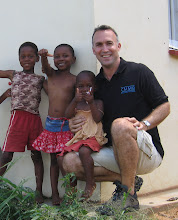
Thursday, February 26, 2009

Four Lollipops

Every week I try to spend one day making home visits with the Home-Based Care (HBC) team Scott works with. The HBC team visits patients in communities within a 50-km radius of the hospital who don't have the means to travel into the hospital for health care. The vast majority of the patients are HIV-positive or suffering from full-blown AIDS. They live in traditional Swazi homesteads, which consist of a collection of huts for various extended family members surrounded by their maize fields and plots of vegetables. At each homestead we invariably find the patient(s) in bed or sitting on the ground, surrounded by other family members -- usually a go-go (old woman or grandmother) and lots and lots of children. Feral dogs and cats and random chickens, goats, and cows wandering around the periphery complete the scene.

Last Thursday we visited a community called Sitsatsaweni -- a very poor, remote settlement about 15 miles from where we live. It's not a village in any sense, just a bunch of homesteads scattered over a wide area of probably ten square miles. The day consists of driving from homestead to homestead, often down tiny, barely visble dirt tracks or footpaths. Scott has become very good at navigating these tracks where most sane drivers would fear to go. At each homestead, the team of three or four nurses assesses the patient and dispenses medication as needed. In some cases the patient is given a referral and money to come into the hospital for further treatment, and in really dire cases, we'll put the patient in the back of the truck and bring him or her back to the hospital with us.

A major part of the home visits consists of distributing food to the homesteads on an "as-needed" basis. Patients on HIV drugs receive the most: a food pack consisting of beans, peanuts, cooking oil, salt, maize meal, and milk. Other patient will receive only the maize meal or milk. The team takes only ten full meal packs a day, along with twenty additional packs of maize meal, and ten 2-litre bottles of milk. The HBC team visits each community once a month, and for some patients this is their only food delivery of the month, so you can understand that in many cases the patients and their families prize these food drop-offs even more highly than the medical care they receive.


On Thursday, as often happens, by the time we saw the last patients of the day, we were entirely out of food. It was an exceptionally hot day, and everyone in the truck, myself included, was tired and ready to head home. We thought we'd seen our last patient and we were all relieved to be headed back to the hospital, when suddenly a thin young woman materialized out of the dense bushes and grass by the side of the road. She held out her medical papers indicating that she is a regular patient and wanted to be seen. Everyone in the truck silently groaned, but Scott pulled over and got out to examine her. She is an HIV patient, but is not acutely ill (aside from being malnourished); she had come primarily to pick up her monthly food pack for herself and her three children. Her homestead is well back from the road and she had walked a ways to meet us when she'd seen the truck in the distance. Unfortunately we had no food at all left to give her. This poor woman looked miserable to begin with, but when we told her we had no food her face fell even further and she looked like the very picture of desperation.

As I wrote in my previous post, people here often mistake me for a doctor, she turned to me and gave me a long, pleading, desperate look. There was nothing any of us could do but get back into the truck and head off. As Scott started the engine, I remembered that we had a few remaining lollipops which we bring along to distribute to the young children at each homestead. I grabbed the bag and found four lollipops inside -- enough for her and her three children to have one each. I told Scott to wait a moment and got out of the truck to hand them to her. As I was doing so, however, I was overcome with guilt that they were all I had to give her. She received them gratefully, joining her hands together to take them from me in the traditional sign of gratitude and respect. We all drove away feeling rotten. Despite all the food we'd distributed that day, or any day, it's the ones you can't help that remain with you.

A postscript: Neither Scott nor I could get this woman and her three children off our minds that night or over the weekend. We talked about it and decided that we had to do something. We would have simply bought some groceries and delivered them on our own, but we had no idea how to find her in that remote area. We asked the HBC team on Monday morning go help us find her -- they know who she is and have records of her treatment -- but due to full schedules and hundreds of other people to help in the communities scheduled for this week, it wasn't until yesterday (Wednesday, seven days after our visit last Thursday) that I was able to go with one of the nurses to find this woman and deliver her some food -- for which she was very grateful. So this story has a happy ending of sorts, but one mitigated, as always, by the fact that she got lucky this time. Who knows what will happen to her in the future, or what will happen to all the thousands of others who aren't so lucky?

Friday, February 20, 2009

Dokotela David

Virtually everyone I encounter at the hospital thinks that I am a doctor when they first meet me -- even many of the other doctors and hospital employees. I suppose I fit the part -- a tall white man, greying at the temples, and hanging out at a hospital. Both patients and people coming in for the first time regularly come up to me saying "Dokotela?" Dokotela is the word for doctor in SiSwati. Quite a few people, even those I have no recollection of ever seeing before, know my name and call me "Dokotela David." (The word for nurse is "nesse." I love the way the Swazis have appropriated English words and made them their own.)

Sometimes, if it seems pointless to do otherwise due to the language barrier or if I'm too busy to stop and go into long explanation, I don't correct the misapprehension, and I just try to help them anyway. This morning, as I stood outside of the Home-Based Care office, where Scott works and which is my unoffical base at the hospital, a young high-school aged girl approached me as "Dokotela Dave." She spoke good English, and told me that she was experiencing some sort of problem with her eye-sight, and it was giving her severe headaches. Since I've been having recurring headaches myself as a result of my tick-bite fever, I felt her pain and didn't want to ignore her complaint. She'd been waiting in the OPD (out-patient department) which is just upstairs from Home-Based Care office, and they'd referred her to the hospital's eye clinic. They'd also told her to buy some over-the-counter pain medication, but she didn't know what to buy and had no money anyway. I told her to buy some Paracitemol (local version of Tylenol) and gave her 20 Emalengani (about $2). She went away happy, and I felt that the interaction had gone smoothly despite the fact that I'm not really a doctor. Unfortunately, I hadn't considered the long line of patients standing nearby waiting to be seen in the OPD. As soon as the young girl walked away, a man and woman came over and told me that the woman had a terrible tooth-ache, she hadn't slept for days, and needed treatment ASAP. I was able to refer them to the hospital's dental clinic, and they too went away satisified. Next a woman with a sick child approached me holding out her child's medical papers. (Everyone here carries their medical records with them in much the same way we carry driver's licenses -- you never know when you'll need to have them on hand.) I've grown familiar with reading them during the home visits I sometimes make with Scott. I briefly looked at the child's medical records, and then gave the mother directions to the pediatric ward. As soon as they left I was surrounded by a sea of others who had witnessed my authoritative handling of the three previous patients. At first I just laughed to myself about the situation I'd gotten myself into, but these people were serious -- they wanted help now. I took the next patient's papers and looked at them briefly and then told him to go upstairs to OPD. The next in line was a mother with four young children in tow. It so happens the woman was a dwarf and was the same height as her children -- maybe three and half feet tall. She spoke excellent English and launched into a long list of each child's complaints. "This one has white spots all over his body. This one has a terrible cough. This one has nausea...." I finally cut her off and explained I was not a doctor. She looked at me incredulously; I don't think she believed me at first. She asked me again, "Can't you help my children, Dokotela?" I smiled at her and repeated that I wasn't a doctor, but an administrator. She smiled for a moment and then launched into a stream of SiSwati, which made everyone in line start laughing -- some of them uproariously. One old man started pounding his walking stick on the ground he thought it was so funny. I didn't understand a word the woman had said, but I caught the gist of it anyway: tall white know-it-all being told off by African dwarf. I laughed too -- partly out of nerves, but mostly sincerely -- it was all I could do in the situation. My nerves were totally unwarranted, everyone remained friendly, and I'm glad that my cluelessness gave them a laugh. Despite the fact that I'm not a medical professional, I've found ways to be helpful both at the hospital and elsewhere in the community, but perhaps this is an important new one: to entertain the people waiting in the endless line for the OPD. They could certainly use a laugh.

Sunday, February 8, 2009

Tick-Bite Fever

I know there's nothing worse than hearing about other people's ailments, but I thought I should take a break from describing all the orphans and other suffering Swazis to elicit some sympathy for myself for weathering my first tropical disease. Sometime within the last ten days or so, I managed to contract typhus, or as it is more prosaically known, "tick-bite fever."

Two Fridays ago, I noticed a small red dot on my left forearm which looked like nothing more than a mosquito bite. Over the next few days it grew and turned red and nasty looking, sending pink branches up my arm along my blood vessels. I didn't feel sick at first, but last Monday evening, as Scott was consulting his medical manuals about the bite on my arm and reading me all the various symptoms and consequences of each possible disease, I suddenly caught a severe chill -- such that I literally ran to my bed and dived under the blankets (it was about 90 degrees out that day). Scott and I both thought it might just be a psychosomatic reaction to hearing too much information from the medical books, but as the night progressed I felt worse, and I didn't sleep much due to severe body aches. The next day, our landlord, Dr. Pons, stopped by and confirmed that I had a case of tick-bite fever, which is something like Lyme Disease, but luckily without the chronic after-effects. My main symptoms, besides the swollen red bite on my arm, were fatigue, body aches, and persistent on-off headache for most of last week. Luckily I happen to live with a very good nurse, so I received world-class medical treatment all week. Unfortunately, Scott himself came down with a pretty bad head cold on Thursday, so he spent the day home from work on Friday. All in all, we spent a rather low-key weekend at Mabuda Farm. Our weekend was brightened considerably by the arrival on Friday of five packages from home. Many, many thanks to Jocelyn, Aunt Peggy & Rick, Will & Stuart, Anne Abbott, and Steven & Gina for their thoughtful and much welcomed gifts. They arrived at the perfect time!

I am feeling much better now (as is Scott), and it seems to have been a relatively mild case of tick-bite fever -- and supposedly I will now be immune to future cases -- for which I am very thankful.

Sunday, February 1, 2009

Monday Morning

I've been intending to write about what I do each day here -- the various organizations I'm working with and the various projects I'm working on -- and I will describe those in some future post. But this morning has already been so busy and filled with so many different experiences that I'm simply going to describe my day thus far. (It is now 10 a.m.)

Scott and I arrived at the hospital at 8 a.m. I have been working with a nurse at the hospital, Deborah Maposa, who is also a community organizer -- or really a mother figure in her neighborhood of Makhewu, to whom many of the local people turn when they need help with problems of any kind: food, clothing, housing, school fees, or medical issues. She's part of the home-based care team Scott works with, and she's kept me busy with referrals of students who need help with their school fees. Deborah and I had scheduled a meeting to discuss three high school students that we have been working on placing in local high schools. When I arrived, the mother of one of the students was waiting to speak with me. She had come to the hospital by bus (actually, small vans, called "coombies" here -- the backbone of Swaziland's transportation network) just to thank me for helping her daughter. She thanked me profusely and at great length (all in Siswati, translated for me by Deborah), praising God at length for sending me to help her daughter. This sort of praise happens fairly often to both Scott and me, and is rather embarrassing, but is a formal and accepted part of the social exchange here. The woman had come a long way just to thank me, so I gave her bus fare for her return trip.

Next, Deborah told me about a particularly sad case, an orphan girl of 15, who had been receiving government support for her schooling, but who, at the end of last week was handed a bill for almost 4,500 emalengani (about $450) and told that her government support had ended. Deborah wanted me to go with her to see the headmaster at the girl's school to see if he would allow the girl to continue to attend classes while we worked things out with the department of education or found someone to sponsor the girl. So we hopped in my car and headed down the road to the high school. (That's one of the things that's both wonderful and exasperating about this place -- you can just show up somewhere, no appointments needed, and meet and work out whatever issue is at hand. In fact, it's probably best not to make appointments, as people often don't keep them, and even if they do, invariably show up late.) On our way to the high school, we saw another student we are supporting walking up the road toward the hospital from town (about a 1/2 hour walk). This student was the daughter of the woman who had come in earlier to thank me, and she thought that she was required to be there as well, so had walked all the way from town. I told her to hop in the back seat and that I would take her back to school when we were done with our meeting at the other high school.

We continued on to our original destination, where we stood in line with a bunch of other anxious parents waiting to see the headmaster. While we were there, Deborah realized that yet another student we are assisting (third one of the morning) was also a student at this school, and that I should meet him so that he could thank me as well. She sent for him, and the young man soon showed up and began thanking me profusely for helping him and vowing that he would be a diligent student and make me very proud to be his son! (I have given up trying to explain that I am not personally paying for each of these students, that I am only working to find other sponsors. To those of you who have sent money or offered to help support a student, I pass all this thanks and praise along to you, and I promise to take pictures of these students and pass them along to you ASAP.) We then met with the headmaster, who readily agreed that the orphan girl could continue her studies while we seek to get her government funding reinstated.

On the way home from that meeting, we dropped off the girl we'd encountered on the road at her high school, and returned to the hospital. I ran in to Scott right away, who was standing there talking with one of the hospital orderlies, a young man who wants to try to attend nursing school in the United States. We told him that he needed to research Swazi and U.S. immigration policies, and that we would do some research on nursing programs in U.S. that might offer scholarships or support to African students.

As we were speaking with this young man, we saw a woman who occassionally cleans and does our laundry for us walking down from the out-patient department with two of her young children -- one on her back and the other holding her hand. She is a lovely woman, and we greeted her by saying "Unjani" or "How are you today?" She hesitated for a moment before saying quietly, "I am not fine" -- her toddler had just tested positive for HIV. This came as a shock to both of us, and she must still have been in a state of shock herself, but, sadly, there is also something so every-day about hearing the news here. She is herself HIV-positive, and she is now very worried not only about her toddler, but also the new-born on her back. Scott counseled her a bit, and then she took off down the road to her house. Scott and I just looked at each other and shook our heads. We had thought she was one of the lucky ones; she has a steady job and seems relatively well-off, but more and more it seems to us that virtually everyone here is HIV-positive. The official statistic of a 40% infection rate, high as it is, seems vastly understated based on what we see everyday.

I have an appointement at 10:30 a.m. in town to meet with an Italian aid agency, so I decided to stop at the internet cafe to catch up on email and write this entry. On my way into the cafe, I saw one of the nurses from the hospital carrying a beautiful young girl of about two or three years old who promptly reached out for me with a big smile. I greeted the nurse, and I asked if the young girl was her child. She said, no, that she was a girl who had been abandoned at the hospital. I remarked how friendly and outgoing the young child was, and the nurse responded with a rueful laugh, "Yes, she is an adorable child -- she has no one, so she is friendly with everyone."

All of this occurred between 8 a.m. and 9:30 a.m. this morning -- a far cry from my quiet desk at the Russell Sage Foundation.

I write all this not to tug on any heart-strings, but just to provide some idea of what passes for normal here -- the continual, ongoing evidence of human need of any and all kinds. Though it can all be a bit overwhelming at times, I must say that I also find it rather bracing and invigorating -- perhaps only relative to what I used to think of as my own "needs."

Thursday, January 29, 2009

Head of Household


(click photos to enlarge)I'll let these photos speak for themselves, except to say that, yes, this family of orphaned children is living on their own, and is now headed by the eleven-year-old girl you see above. They receive one visit a month from the Home-Based Care team Scott works with, and they also receive monthly food packages from World Vision International.

Tuesday, January 27, 2009

Back to school


One experience I never anticipated having while here (or ever in my life, for that matter) was going back-to-school shopping for kids of my own. Yet that's exactly how I spent my entire morning yesterday. Let me explain...

The new school year begins in Swaziland today, and over the past week, many poor parents (and other child guardians & caretakers -- since so many kids' parents have died) have been desperate to get their children enrolled in school. The primary obstacle, as with so many things here, is lack of money. School here is not free. Everyone must pay school fees. Most primary schools charge around $200 per year, and high school costs around $500 a year. That may not sound too expensive, but in a country where the average income is less than a dollar a day, you can see that those charges put school entirely out of reach for many families.

Many of the other volunteers here pay for one or more student's yearly school fees. Scott and I had decided we would do so as well, but hadn't been approached -- until last Friday. Scott was wrapping up his day making home visits when he came across a particularly desititue family -- both parents dead of AIDS, and their two chilren, a 12-year-old boy, Marcoba, and and 13-year-old girl, Nosipho, are now living with their grandmother, who is herself ill, and their paralyzed uncle. It sounds like something out of Dickens, but it's all true -- and all too common here. Scott called me, and we agreed that this is the family we wanted to support. We got the necessary forms and spent a couple of hours on Saturday morning waiting in line at the local bank to pay the school fees for these two children.

Yesterday morning (Monday), Nosipho was waiting for us at the hospital at 8 a.m. She had probably walked about 3 or 4 miles to get there. We had arranged for her to meet us there so that we could give her the bank receipt verifying for the school that their fees had been paid. They also needed some school supplies, although they are going to make due with their uniforms from last year. Both are very small and slight kids for their ages; they look more like an 8 and a 10 year old than a 12 and 13 year old. Nosipho, the young girl, is shy and reserved, and seems wise and resigned beyond her years. Her brother, Marcoba, is a typical young boy, a bit devilish and charming and eager to show off.

In any event, Nosipho hopped in the car with me to go pick up her brother for a shopping trip in town. She lost a bit of her shyness in the car and gave me expert directions to her homestead, which isn't far from town, but is down many winding dirt roads ending in nothing but a rocky track leading to their home. We picked up Marcoba, who quickly relegated his older sister to the back seat and began telling me how to get back to town. We went to PEP, the local (much smaller) version of Target or Wal-Mart. It was a mad-house. Mothers with their kids in tow, were packed into the store buying back-to-school clothes and supplies. I was the only white person and the only male shopper in the store. Luckily, a kind saleswoman saw me looking lost, and came over and took charge. We ended up with new backpacks, sweaters, socks, underwear, and shoes for the kids. Marcoba wanted to buy everything in sight, but his sister, Nosipho, did a good job restraining him and letting me know what they really needed. After PEP, we went grocery shopping so they had some food to take back to their grandmother, and of course I had to get them some a couple of treats to mark the special day -- for them and for me.

The whole experience raised mixed emotions for me. Of course it felt good to be able to help those two cute kids. I fell in love with both of them, though Nosipho especially captured my heart with her sad, sweet smile. But it also made me feel sad for them that they have to live this way -- and they are among the lucky ones! They found someone to help them, while so many others have to go without. And what will happen to them down the line? There is something very wrong with a system that charges so much for school, asking so much of people who clearly cannot afford to pay. The problems here are immense, and school fees are only part of it. We, like most, are just doing what we can to help those in front of us, and I try to keep that in mind and to be content with that, but the thought of all those who aren't being helped, who can't go to school, who have no food or water, is a constant nagging thought in the back of my mind.

Friday, January 23, 2009

One Reason I'm Here

(click photos to enlarge)

The glimpse of a child on a movie screen played a significant role in bringing me to Swaziland. Scott and I were still considering whether or not we really wanted to come here, when we went to see the documentary film "Without a King" sometime last spring. Towards the end of the film, there is a brief shot of a lost-looking young boy at an orphanage here. One of the king's daughters is distributing food to the orphans, and, when this young boy is given his share, he looks confused and vacant and almost hurt because he is so unused to receiving anything or having anyone notice him at all. His lost look haunted me long after leaving the theater, and whenever I wavered in my resolve about our decision to come here, the thought of the look on that young child's face sustained and strengthened my desire to come here and try to help in some way.

Now, it is the looks of children I have witnessed since we've been here that inspire me: of Thembeline, a 13-year old girl with TB and HIV, who is the only caretaker for her sick and blind grandmother; of a six-month old HIV+ baby, crying weakly because his mouth was so full of thrush; of an eight-year-old boy, Mthobisi, also HIV+, wandering down a muddy road in his pajamas all alone to meet our truck, because his mother was too sick to accompany him -- he wore a look of infinite resignation on his face, and showed only the faintest glimmer of satisfaction when we gave him some candy to suck on while Scott examined him. And last week, at a homestead full of children and HIV and TB, a young adolescent boy, perhaps 13 years old, nattily dressed in a shirt, vest, checked coat, and striped shorts -- all mismatched and ragged and dirty, but still worn with pride and a sense that he had chosen those clothes carefully -- and his wide, toothy, endearing smile, somehow yearning for attention among all those other kids. He wasn't sick, he was just one of a dozen or so children in that family, and I sensed he was a bit lost in the crowd. Whenever I'd catch his eye, he'd smile broadly but shyly shrink into the group of people gathered around the truck. I went over and shook his hand and said hello, but the language barrier kept us from communicating beyond that. All I could do was give him some candy and pat on his shoulder, but his shy smile has stayed on my mind -- all of their looks have stayed on my mind.

For me, a big part of this journey is figuring out how best I can help such kids. As I wrote in my first entry, I believe that even small steps can make some difference. Perhaps my smile and that pat on the back encouraged that young boy in some way that day. I'd like to think so, but I don't know.... I think I'll still be trying to figure it out long after we leave.